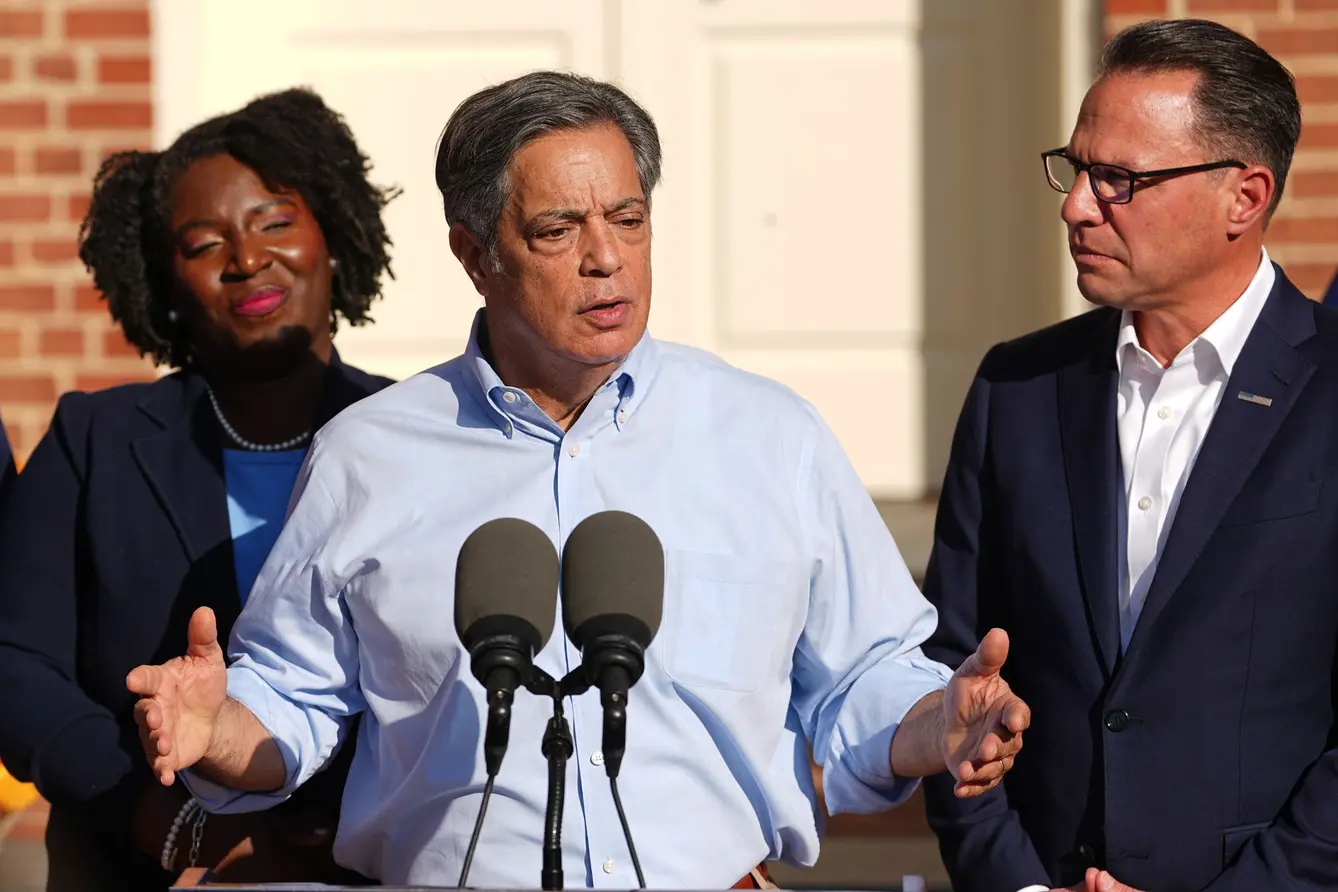
HARRISBURG — Hot off winning a trifecta for the first time in more than 30 years, Gov. Josh Shapiro and Democratic legislative leaders laid out a vision for rapid action they say will offer relief amid rising costs and restore trust in government.
“What last night’s election showed is that I have a mandate to continue to lead our commonwealth forward,” Shapiro, who romped to an easy victory, said at a news conference at the Governor's Residence in Harrisburg on Wednesday.
Flanked by Lt. Gov. Austin Davis, top lawmakers, and four Democrats who flipped state Senate seats, Shapiro said the party will soon announce a policy agenda for the first 100 days of governing.
He did not provide an exhaustive list, but he said he can “guarantee” they’ll accomplish the following: “We will fund mass transit. We will raise the minimum wage. We will make sure that women have a right to reproductive freedom here in this commonwealth. We will build more housing. We will allow survivors of abuse the ability to confront their abusers in court.”
Pennsylvania’s midterm voters elected four Democrats to state Senate seats currently held by Republicans. A Democratic incumbent also lost his race, meaning the party will have a 26-24 majority in the upper chamber.
Democrats also expanded their majority in the state House by at least eight seats, giving the party 111 members in the 203-person chamber. The Associated Press had yet to call four races as of Wednesday afternoon.
The party’s gains were concentrated in the eastern third of the state outside Allentown and Philadelphia.
“It's not just a one-seat majority,” state House Speaker Joanna McClinton (D., Philadelphia) said at a separate news conference Wednesday on the steps of the Capitol. “It is a mandate to respond to the needs of this hour.”
Democrats plan to advance a bill to increase the state minimum wage first, party leaders indicated Wednesday. The wage is currently $7.25 an hour, the federal minimum set in 2009. Pennsylvania lawmakers last voted to increase it in 2006. State Sen. Vincent Hughes (D., Philadelphia) said he wanted to “double that sucker.”
There are many other policies that Democrats want to address. Lawmakers who talked to Spotlight PA named paid family leave, legalizing recreational cannabis, stricter rules for data centers, expanding voting rights, and allowing citizen-led referenda as additional issues they wish to tackle.
State Rep. Izzy Smith-Wade-El (D., Lancaster), a member of the Progressive Caucus, acknowledged that Democrats’ opinions vary on policy details — like how high to raise the minimum wage — but he said he expects his peers to “have a big family dinner” where they reach consensus on key priorities.
Democratic lawmakers will need to “pick and choose which hill you're going to die on,” Michael Manzo, who was chief of staff to a former House majority leader and is now a lobbyist, told Spotlight PA.
“If [conservative Democratic state Rep.] Frank Burns has to walk away from the table unhappy with the deal struck on minimum wage, for instance, you know he can also get some of his long-held policy victories done under a Democratic majority,” Manzo said.
In a statement, state House Minority Leader Jesse Topper (R., Bedford) rejected the notion that Democrats’ trifecta means they have a blank policy check. Instead, he argued that the results only indicated “dissatisfaction with the national direction.”
“The election results were not a mandate to run the far-left, collectivist wishlist broadcast by this nascent Democrat trifecta,” Topper said. “If this is the road they are determined to go down, they will find not only myself and my caucus in opposition, but also every Pennsylvanian who wants their freedom and their way of life protected from radical government intervention.”
A spokesperson for Senate Majority Leader Joe Pittman (R., Indiana) did not immediately respond to a request for comment on the election results or what they mean for his leadership of the caucus.
A brand new majority
The top two leaders in the state House, who have wielded power for most of the past four years, will remain unchanged, lawmakers suggested to reporters Wednesday.
Since Democrats flipped the state House in 2022, McClinton and Majority Leader Matt Bradford (D., Montgomery) have worked to maintain caucus unity despite a bare majority and politically wide-ranging caucus. Now, they’ll have a larger cushion.
Asked about any potential leadership shakeups, Bradford said it’s ultimately up to his caucus to decide, but he also noted that his is the “easier” chamber this time.
The bigger change is in the state Senate. Minority Leader Jay Costa (D., Allegheny), first elected in 1996, a few years after Democrats lost the upper chamber, has led his caucus through the political wilderness since 2010. It appears he will be his party’s choice for president pro tempore — Shapiro, McClinton, Bradford, and Hughes each referred to Costa on Wednesday using the title. (The entire Senate will vote to elect someone to that position as early as November; they must secure a simple majority.)
No one would discuss which Democrats plan to run for the caucus’ top jobs, including majority leader and Appropriations Committee chair; such positions are selected solely by members of the party.
Hughes, specifically, would not say to Spotlight PA whether he plans to run for majority leader, simply noting that he has “really enjoyed” his current role as minority chair of the Appropriations Committee and hopes members retain him.
Whoever they are, Democratic leaders in the Senate will be tasked with keeping their politically wide-ranging members rowing in the same direction with a very small majority.
Bradford managed to do so in the state House as he championed business-friendly tax and regulatory policies alongside traditional Democratic priorities like a minimum wage increase, stricter gun laws, and labor rights. He said this approach is a product of having a “humble” majority with no room to lose even a single Democratic vote from anywhere on the ideological spectrum.
Speaking to reporters Wednesday, he indicated he would keep this governing philosophy.
“We have a mandate, yes. But it's a mandate for what we talked about when we were at 102 — humility,” Bradford said. He added that the last two sessions have “shown a better way in the state House — a pragmatic way, a thoughtful way, a way that recognizes that when Democrats lead in a pragmatic, aggressive way, we can be both popular and we can be successful in delivering on the very change that Pennsylvania so desperately needs right now.”
Senate Democrats will have to navigate similar ideological divides as the caucus learns to function as a majority.
State Sen. Lisa Boscola (D., Northampton), a self-described moderate from the Lehigh Valley, has frequently broken ranks with her caucus on issues like banning trans girls from school sports (she supports the proposed restrictions). She said compromise is going to be key.
On the minimum wage, for instance, she said she would be fine with $15 an hour: "If they talked about $20, I would say no." She also said she'd support data center guardrails, but not a moratorium.
“Any one person in the Senate can say, 'You put this in a bill; I’m not voting for it,' and then it’s trouble,” she told Spotlight PA.
Progressive state Sen. Nikil Saval (D., Philadelphia) is also already thinking about consensus, telling Spotlight PA the moment “is not about red lines, drawing lines in the sand,” but about “governing and delivering for Pennsylvania.”
“People want to dream big, and they want to fight hard for things,” he said. “That's widely felt across our caucus, and I think in some ways we haven't even allowed ourselves to do that because … with Senate Republicans in charge, it might have seemed fanciful or futile.”
Another progressive, state Sen. Katie Muth (D., Chester), was slightly more cautious. No matter which party is in charge, she said, a lot of money flows through Harrisburg and influences policy. She pointed to key issues for voters, like data centers, adult-use cannabis, and skill games, as examples of issues that are heavily shaped by lawmakers’ relationships with lobbyists and donors.
“I hope corporate Democratic policies are not what this trifecta is focusing on,” Muth told Spotlight PA.
Tony Lepore, who served as chief of staff for Senate Democrats when they last held the majority in the early 1990s, said the trifecta is “going to open up a ton of opportunities” for the party. He noted raising the minimum wage is likely to happen, and he expects Democrats will try to address some federal healthcare cuts.
But governing in the majority will not come without obstacles, he said.
Individual members may feel they have more bargaining power to sway policy — especially given Democrats hold a narrow one-seat advantage — and some may feel passionately opposed to proposals the rest of the caucus supports, said Lepore, now a senior adviser in the government affairs and public policy group at Ballard Spahr.
“It's not easy leading a caucus, whether you're Democrats or Republicans,” Lepore said, hearkening back to his firsthand experience in trying to keep a majority unified on issues. “I think it's even harder today because we have a wider range of people in the caucus with different viewpoints, and from the left and the center, there's more moderates.”
Not all priorities are policy-centered. Mary Isenhour, a lobbyist who was chief of staff to former Gov. Tom Wolf, told Spotlight PA that the new trifecta should focus on something less tangible — “bring civility back to government.”
“Treat colleagues with respect,” she said. “Be gracious winners. Be gracious losers.”